Showing posts with label creative business. Show all posts

Aug 13, 2026

Exhamined, niche nothingness

That was always the neoliberal market advice, and I'm not sure if I'm following that right now. Of all things, like what you're going to do with being a niche of something finite unless you buy advertising.

So now we are going to go and see if these things will work, and if they don't, I'll go and try to see if I can function in another way. They will discover you; they will find you, put you on a list, and categorise you in a box. Then they will just go on, silly little elitists wanting their product to be consumed. 

It's all prosumerist all the way down, and I don't care anymore. I don't want to be a part of it.

Jul 4, 2026

Beyond Bwubbles, Onto new analogy


🔮🛋 In this economy? Opinion time for Couch Gregor. 
The arms race. The prisoners dilemma, the buzzwords.

I'm not keeping track of this.

Update, there's a bubble discourse with this. As there are too many cooks. Speculative theater ahead.

To this

And Ezra Klien attempting to sort it out. Yet this confused puff of smoke. IDT it will lead in

This everything is so fast with the concept of the bubble coming in 2022, I've decided to move on with a new state of economic transformation in iterations. Something that IDK what is happening so I'll repost my thoughts. To the Ron Paulisation of everything.
Look at all those pundits I can't keep track off! Weeeeeeeeeeeeeeeeeeeeee


Lets see the historiography, Karl Marx's 3 capital book on economics, boom'n bust. Yet, We know at a glance, there are odd interpetism thanks to the postmodern era.
  • Ed zitron. Gloatmaxxing As far from the rumours that the bubbles got the pop with embarrassments, and with his news later, which I have no influence over along with no kinship. OOOPS well he's wrong thanks Ben Garrison. Don't give him any money to his newsletter as he putts S&P stocks and sells digital lawyers.
  • Peter Thiel and Mark Anderson and the and copyrighting have taken a different approach to the bubble, saying it's going to lead to abundance, said whole Boomer, utopia of some kind well, or something idealistic of that nature. Nah. (nope) 
  • The concept artists themselves fake-believing with the copyright nuke. Think that the bubble will just automatically extinguish, including there employer Disney. Itself into a world of ultimate peace, it's still long going, it's getting more tropeish and predictable by the second, ignored in the low Tier. On that corners of the microblogs that's where it will exist.

    You can't laborwash copyright maximilism, sorry. Gotta go labor wars, job garenttes with the social contract.
  • The YOU WILL LOOK SO INCOMPETANT WHEN IT POPS DUMMY by one of the intellectuals on substack I quoted on substack on cloister. Nah, one poster came as supremacist. Idk something else. It felt like more a showboat rather than a manner to like it. (Post edit, he's went 180 and hates it too with the job annihilation job disappointment,)
  • My personal is the reverse pop with social contract reform being a copyright minimalist, I've already covered it in my hub with 50 yrs and inherent moral right. This is still my only ideal with this. <back to that

    Now lets give the idea the best belief and doubts, yet I believe we have to blame the human condition have nov 2022. From the Union Organiser. Yeap, for public intelligence.

    "It's a bubble

    Yes, AI in the West is a bubble. It's similar to the dot com boom of the early 2000s: huge, risky investment for a potential future payoff that does not seem to be coming. But overvaluation is not new, we have historical examples to analyze and we see that after the dot com bust, the Internet did not go away. Rather what happened was that some companies disappeared, and their property, talent and infrastructure was acquired by what are now today's giants: Amazon, Google (now Alphabet), eBay, Cisco, Nvidia and Oracle. They acquired talent and property on the cheap during the bust phase and 20 years later decide for us what goes on and where on the Internet -- Amazon and Google especially. Fun fact: Amazon's real money-maker is not their online store, it's their Cloud service named AWS. It hosts over 1 in 20 websites (5% of the entire Internet) by some estimates, most of them big household names.

    The boom and bust cycle was clearly explained by Marx. A new market emerges, capital floods it and tons of new companies open (the boom phase), but then overproduction lowers the rate of profit: a sizeable portion of the companies that opened during the boom go bankrupt and we enter the bust phase. But an equally important part of Marx's analysis is that not all companies go bankrupt in that phase. Those that remain solidify their position in the market, and become monopolies. The boom and bust cycle doesn't just explain economic crises but also the tendency of capitalism to form monopolies.

    The belief that AI will go away after the bubble pops is supported neither by theory nor by historical examples. Not only will open-source models still exist and be available after the bust, not only will research into neural networks still take place (by very skilled engineers might I add, who are often completely ignored in the conversation), but what will happen is AI will get consolidated into fewer companies. And yes, I do believe AI in the West is an overinflated bubble, predicated on capitalism's own contradictions (the inherent 'anarchy of production' as Engels said and the incessant need to open up new markets because of the tendency for the rate of profit to fall): they are trying to make it profitable and pumping money into it to get a return on investment. But as Chinese models show, AI is actually not that big of a market; it's overvalued.

    When Deepseek-r1 came out in January of this year, it completely destroyed the western model of the AI market. Deepseek is a smaller model that came out of nowhere (the parent company is a trading company, so not in AI or even a "tech" giant originally - though they are a giant of trading in China), trained on less than 100 million dollars versus the 1 billion USD openAI swears high and low it absolutely needs to do literally anything with. And yet, it delivers similar if not better results in its generations. Suddenly, the investment into Western companies doesn't seem viable and people, both investors and users, are realizing they got taken in by capitalist promises.

    What we need to do when it comes to the AI bubble is placing it in its proper theoretical context. Personally I'm not even sure what the people who hope for the bubble to burst actually expect to happen afterwards. A part seems to believe that all AI will suddenly vanish because openAI will close down, while another part expects that it will...? I truthfully don't know. Like I said, it's a simple argument to end all conversation: the bubble will burst, so just wait for it. Nothing else needs to be said.

    [Update March 2026: OpenAI has just announced that it was going to shut down its video-making platform Sora,[1] exactly as I predicted as part of OpenAI being an early provider, but then failing to keep up with later advances from newcomers like Anthropic and Deepseek. The GPT yellow filter on image generation was another such failure of being an early provider. This shouldn't be taken as a sign that AI is going away however; as the tool is maturing, more clear-cut usecases appear and right now, everyone is going in on agentic, a method of using LLMs that let it interact with your machine, running shell commands and programs as it needs to fulfil a task you give it. If you're interested in agentic check out this lemmygrad community to get started with open-source tools. In any case, the rush to agentic has happened partly because agentic work uses a lot of tokens, which means a lot of API calls providers can charge for, but also because it integrates really well with LLMs and their semantic understanding of language. But don't expect that AI as a whole and even video generation will disappear from this, it will simply move to services you may not ever hear about unless you look for them, taking on a different form, and so one shouldn't make the mistake of covering their eye with a leaf to make Mount Tai invisible.[2] Chinese providers that have made their video generation models free to download and run locally (Hunyuan, Wan AI, Hailuo) are not shutting their platforms down, because they have nothing to 'shut down'.]

    But things do need to be said. What will we do when this bubble crashes the economy? It's not just tech companies investing in AI, it's pension funds, banks (using your money), your employer and even school boards! Everyone that has some cash lying around basically. We are gearing up for a 2008 crisis, if not worse. Instead of wishfully thinking that all our problems will get solved by the contradictions of capitalism, the time to organize the workers and prepare for the crisis is now, before it actually happens.

    And when we see that a company like Microsoft (i.e. legacy tech giants) is buying up shares in openAI to the point that they now own over 27% of the company,[3] it seems pretty clear to me why they're not waiting for the bubble to burst to buy at cheaper prices: when openAI goes bust (because their only product is AI and they survive on investor money), it will get carved up in liquidation, and Microsoft will be right there to appropriate everything they can: the talent, the infrastructure, the LLM models, and so on. A process of monopolization will happen and established companies are gearing up for it.

    In other words, ChatGPT might disappear, but it'll resurface under the name of Copilot.

    Microsoft is not the only one. Google (Alphabet) is buying up AI startups, though this process is not new for them. It lets them get rid of competition before it even has a chance to get off the ground and consolidate their own AI product. Salesforce is investing in Anthropic, the makers of Claude.

    And I'm not sure what will happen in the AI ecosystem after the bubble bursts either, but I know that it will happen whether I want it to or not. I can't will it out of existence. What I do know is that some monopolization will occur in the West while China will continue its research, but I'm not sure what this shift will mean materially. It's too early to tell until the moment it happens. What we need to do is prepare and organize now before it strikes."

    Another to the concept is within the infrastructure of the Frontier LLMS Funding of decentralised diffusion. Now we reach To the ai as normal tech take.

    So there's this

    "As AI labs race toward Recursive Self Improvement, there’s a possibility that what they are actually racing toward is Recursive Self Extinction — of their business model. Here’s my reasoning.

    1. Progress on verifiable tasks continues. In particular, improving the cost efficiency of existing capabilities is a highly verifiable task. For the past few years, cost per equivalent capability has dropped by at least 10x per year. I think this progress will be sustained for a few more years, and even accelerate as labs use AI more and more heavily for AI research in the pursuit of RSI. There is of course a ceiling to efficiency improvements, but I don’t think we’re close to that ceiling.

    2. Progress on most unverifiable tasks remains frustratingly hard. AI inherits the same limitations (ambiguous success criteria, slow and noisy feedback) that limit human performance at tasks ranging from writing to governance. The optimization paradigm generally doesn’t result in superhuman capabilities on such tasks, because whatever proxy you optimize for gets Goodharted. For example, I recently pointed out how over-optimization explains Claude’s overly dense and ornamental writing style that’s since been dialed back.

    3. RSI ends up being narrow. A consequence of the above two points — even if some version of RSI is achieved, it results in an explosion in some dimensions (efficiency, verifiable tasks) while falling short of producing something that is superintelligent in any real sense or capable of automating a broad swath of jobs in the economy.

    4. More than one lab stays at the frontier. This means the market will remain competitive, and developers can’t charge high margins to compensate for rapidly falling inference prices. Any compute scarcity that allows higher margins is temporary, in my view. I also think it’s likely that most of the innovations continue to make their way into open-weight models with some lag, so open-weight models are at cost parity for inference or only slightly more expensive. Note that efficiency tricks and verifiable capabilities tend to leak much faster than unverifiable ones. Distillation could be one reason, but simply knowing that something can be sped up 10x tends to have a focusing effect on research and innovation.

    5. Jevons’ paradox is not a magic bullet. If the above points hold, there are very few applications that will consume so many tokens that they could generate the astronomical amounts of revenue implied by the labs’ valuations. We’re talking about a 10x growth in tokens year after year, just to keep revenue flat given falling prices.

    Even today’s behemoth tasks like migration of million-line legacy codebases will likely become cheap within a few years. While new applications will open up, there won’t be orders of magnitude more new ones. As for unverifiable tasks, inference scaling rapidly hits diminishing returns. Ultimately you have to have a human in the loop who’s accountable for the result. Spending more on tokens doesn’t let customers escape that responsibility — and only makes the human review bottleneck worse.

    6. What about scientific research? Science is an endless frontier, and more tokens could perpetually mean more discoveries and inventions, in theory. But the unfortunate thing about research is that researchers don’t get to capture the value it creates, which is why it requires government funding in the first place. Even if it’s true that AI could enable great scientific innovations, I don’t think AI companies will make much money off of that. I think they are currently investing in AI-for-science not as a future revenue stream but as a loss leader because they want to show the public that it could be beneficial to humanity.

    7. The one escape hatch is moving “up the stack”, by which I mean quickly transitioning from selling tokens to an enterprise software like model that relies on high switching costs, deep integration into workflows, and control over systems of record. In this world, enterprises will purchase “digital workers” or pay per solution (e.g. resolved support ticket) rather than tokens, so it’s good or neutral for AI companies if inference costs fall. And open models don’t matter as much — Linux being free didn’t make most enterprises switch away from Windows, because they paid for polish, peace of mind, support, and familiarity, not the code itself. I think this is the labs’ best bet for becoming sustainable businesses (though the potential lock-in is concerning for their customers!). The problem is that the labs have many hurdles to clear to get there, most of all their mindset, and the faster they race toward RSI, the shorter the window they give themselves for this transition. The pure-play AI labs are the ones who are farthest from being able to make this transition, and AI companies with a long history in enterprise software are relatively well positioned.

    In short, the race to RSI ends up being a race to eliminate the labs’ main avenue for capturing the value that they create — the fate of many past transformative technologies such as railroads, airlines, and fiber.

    The labs’ bet is that RSI produces a durable, decisive lead that escapes commoditization. My view is that there are two different improvement loops that have been conflated, and they will come apart. The efficiency improvement loop will accelerate, but a broader improvement loop that might lead to AGI or superintelligence will require ever-increasing amounts of compute, talent, data, and real-world feedback that can only come from gradual deployment, and the money to fund all this will have to come from massive revenue growth. And the irony is that the first improvement loop is undermining exactly that revenue growth.

    The premise in my chain of reasoning that I’m least confident in is #5 — that Jevons’ paradox will eventually stop being able to compensate for efficiency improvements. A few months ago I was much more of a believer in continued, nearly unbounded token volume growth, but the more I’ve thought about it the more skeptical I’ve become.

    To better understand why the premises and outcome I've laid out are at least a possibility:

    * My AI-as-normal-technology essay and follow-up writings with Sayash Kapoor on our newsletter normaltech.ai

    * My ICML talk laying out my skepticism of the claim that RSI will lead to superintelligence normaltech.ai/p/what-wi…

    * Ramez Naam’s review of the evidence questioning the prospects of an intelligence explosion noahpinion.blog/p/where…

    * My piece with Akash Kapur on whether AI labs will move up the stack normaltech.ai/p/up-the-…

    * Many pieces by Nathan Lambert such as “I expect rapid progress but not towards general superintelligence.” interconnects.ai/p/i-ex…"
    Yet, we must not fool ourselves with decentralised networks, they are still here.

    Oh yeah, the predominant 'left' also predicted that with niche, and I've taken to it's rhetoric of it's many corruptiosn
    Bitcoin, look how that turned out. I already covered it here.
The most plausible from a solitary cautious optimist, through the different variations, that there's going to be a quiet revolution of academics and other thing that is the one that feels the most plausible bubble right at this moment. Quiet with agile firms.

What if it's not a bubble yet? Other self reconstructing Bridgestone? The llm compatibilism.

One trying to reconstruct and build together once with each new filter list with each block and reconnection of construction. Blocks and discovery's from the connectionist substrate, to the reconfig an return and overlook of the relation of elite and popular, and the return to a natural duty.

When that comes, it's a matter to reunite and see which from the commodified community's that are made, it's the populist de-emergence of the matter of the integration of society. That's a speculation.


Back to the equilibrium, from a synthesis of many and one.
What foxkey is claiming there's an illogical bubble? Idk.


https://nymag.com/intelligencer/article/the-all-or-nothing-vibe-shifts-of-the-ai-industry.html

Oh, blame the Hypers too. Good, bad. or not, Archive version


Conclude @pojmasta done his work,

With all of that, as a mixture of being normal and ethical with it. I'm alright.
So, even with the projections of violitality of the 

Now to attempt an educated answer .Peeps need to confront that to consume such stuff.

Lookit these grafts like in freddy got fingered 🛋📊📈 So don't take me as authority.

So no, Supply and demand, get there is no better with this crude economic analyse, Here are some concepts. Yeah, it's on us, along with that. With It going in.. 2030 it looks like until it goes down?


Apperently Patrick Boyle as this graphic her, erm does this look like the Gartner Hype Cycle? Or How money works.
Ain't a authority on this, Sooo everybody on substack with all this makes it the case.
Away from Hollywood, Away from Silicon Valley. Away from the early critical theory.

Don't be a D__K still holds true with these systems. Complaints being that of the human conditions with Marx being a neutralists. What if we've been illusory magic fluctuations and we the average voter of a American democratic society are the problem?

The human condition.

This is not to talk about the inevitably or that, I'm a non-normative naturalist by heart, yet the viral ones within microblogs don't get it.

Question is capitalism within potential sino-opnions one may disagree with, I've been following 4dime for a while. 

(Oh a muted that name because he's a censoring prick
So I don't know as we ignore the hype.. and the stupid Manichean framing of anti-pro of false binary. The Open Source and china


Open Source Arg.Min Yeah more graphs. From modern times with China coming and bringing Beep boop.
"Because China is exporting to technically advanced, high-skill, high-wage manufacturing sectors such as automobiles, industrial machinery, chemicals, and precision tools, the second China Shock is hitting Europe harder than the US. Germany, Europe’s largest economy, is especially vulnerable. Germany bet its economy, its national identity, and its legendary social contract on dominating the market for high-end gas cars. China bet on electric vehicles built rapidly, cheaply, and at “good enough” quality. China’s bet is paying off — and the result is China Shock 2."
Oh look took a comic from an infamous cartoonists, reapproipated it what a polemic, what a time. Wow, A it does not matter if they shot themselves in the foot in 2023, they don't care. Self-flagellation. What are we going to do with all this response raites
Argh, guy you hate makes a great point.
I'm not going to hold my breath.
So yeah, that's what this is we are angry at the human condition. The desire for cheaper goods and services, at ourselves. 

Appreciate metrology, (Got recommended this by a gay fox free to read, Haven't read it yet, so I'll share it here.) Regardless, it's been added to growing reading lists of limitless knowledge already.

Look up ya concepts! Aah, Touch grass.

"So on the topic of Bitcoin: the CryptoTicker article treats Bitcoin’s lack of a crash alongside Chinese tech stocks as evidence of cryptocurrency’s independence from traditional markets.

But why was Bitcoin supposed to crash in the first place? China banned cryptocurrency in 2021 and reaffirmed that prohibition earlier this year. Knowing this, no one should think a speculative asset China has spent years restricting would fall alongside China, if somehow China were indeed collapsing.

It’s like saying that because RAM prices are so high, I don’t know, bananas should be expensive too.

I cannot overstate this: the stock market isn’t the economy. A stock can lose half its value without the company losing half its business (or any, theoretically speaking). The S&P can soar while everyone struggles."

It's this all over again. Chill out.


Jun 20, 2026

Living in technoconnectionism of deep pluralism

Such a land like this was made to connect or disconnect us.

That was the ground to make things scarce and then together. What the amount given through each amount is done.

🛋🧩

Idk how to

Benjamin Studebacker said that theres a deep pluralism that one can't escape with community making, and there's going to be ways to resolve.

Nov 13, 2024

Vain glory oxymoron

There is the worst schedule in the world, within the libertarian dystopia, it could be one's own.

Still thinking about how vain-glory this Stockholm condition to capitalism is, Insecure status roles lead to lying about work-schedules that and the exploitation of passion an industry addicted to mass-market advertising.

What a way to indicate as little passion and to creative industries.

A pull the ladder behind oneself.

Greg Capullo has been... lying about his work schedule, and there are others who lie about their work-hours too. Only with my sensitivity with a physical coach and my own.

These syllabuses of others life will never translate into your own, regardless of the truth. Should not degrade into Tik-tok Clip farming, edited for SEO.

Professionalism is whatever they want it to mean for them, including getting dominion.

Since then, He may have back-peddled, yet this advice will all crop up again like the Bulgarian training split, it refuses to die because sex sells.
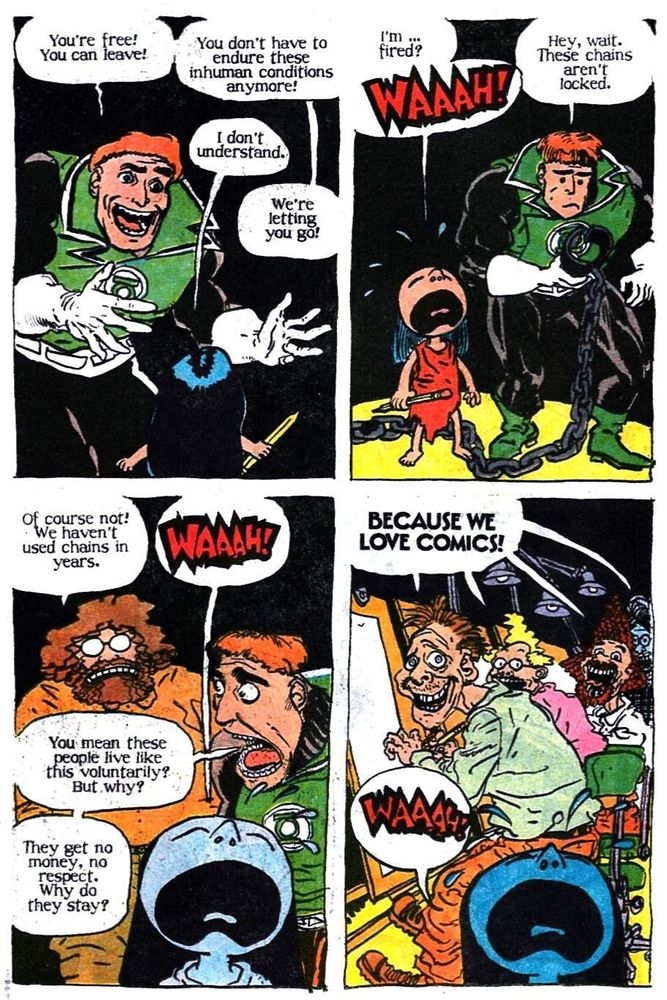
‪Colin Spacetwinks‬ ‪@spacetwinks.bsky.social‬
·4d
"to this day still cannot wrap my head around direct market comics pros and them not just being relentlessly exploited, but frequently being eager about that exploitation, proud of their exploitation, instead of once ever thinking "the way our bosses treat us is ****** up"
this Justice League America page by Kyle Baker came out in May, 1991. It is 33 years old and you still see comics pros enthusiastically acting like this


the only group of creators that i think ever act this ******* eager to get ****** over instead of acting in their own interest against their bosses and publishers is like. Y.A. fiction writers

*** still remembering when BOOM! only paying $50 a page for artists for awhile was *a publicly known thing* and plenty of comic artists were still going "yeah i'll take that job". you'd get better pay for far less work doing a handful of SFW fursona headshots on a twitch stream

comic pros are so frequently a very strange combo of being incredibly prideful but simultaneously having very little self-respect or ability to act in their self-interest"


‪Matt E. Reals‬ ‪@innerpartisan.bsky.social‬
"You'll find the exact same attitude with many people working in creative industries, like animators and video game devs. Stockholm syndrome for capitalism coupled with insecure narcissism for the own status, I'd say."


Cheryl Lynn Eaton
‪@cheryllynneaton.bsky.social‬
Sorry to log back on and jump into being depressing, but...for what? 1995 is not returning. You are not going to become Capullo by sacrificing friends and hobbies. You cannot become a rich man via comics anymore. And you don't have to sacrifice your health or a social life to be a great artist.
Deleted
October 24, 2024 at 9:18 PM
18 reposts
93 likes
Imagine breaking your back and stressing yourself out for poverty. Baby, that is INSANE. You have a better chance getting rich with scratch-offs. I am so serious.
If you love comics? Make comics. Make them on the side as a hobby. Do not expect to become rich from them. Yes, even if you are incredibly talented. And fast. Also, the industry doesn't give a **** about you. Because NO industry gives a **** about employees.
And I'm not saying this to be mean, but to prevent another me. Big-name creators giving advice on breaking into comics is like a Boomer who bought his million-dollar house in 1974 for $20,000 giving real estate advice.
You go to a Capullo or Lee for advice on the artistic process. Perspective, shading, breaking down a stellar action sequence. They are BRILLIANT. Don't go to them (or ANY '90s/'00s star) for advice on how to get rich or get on Batman in 2024. They don't know.
100% this. Their skill is largely (and will likely remain) unmatched. They are artists in every sense of the word. But they do not know - and can never know - what it is like to start in their industry *now*.